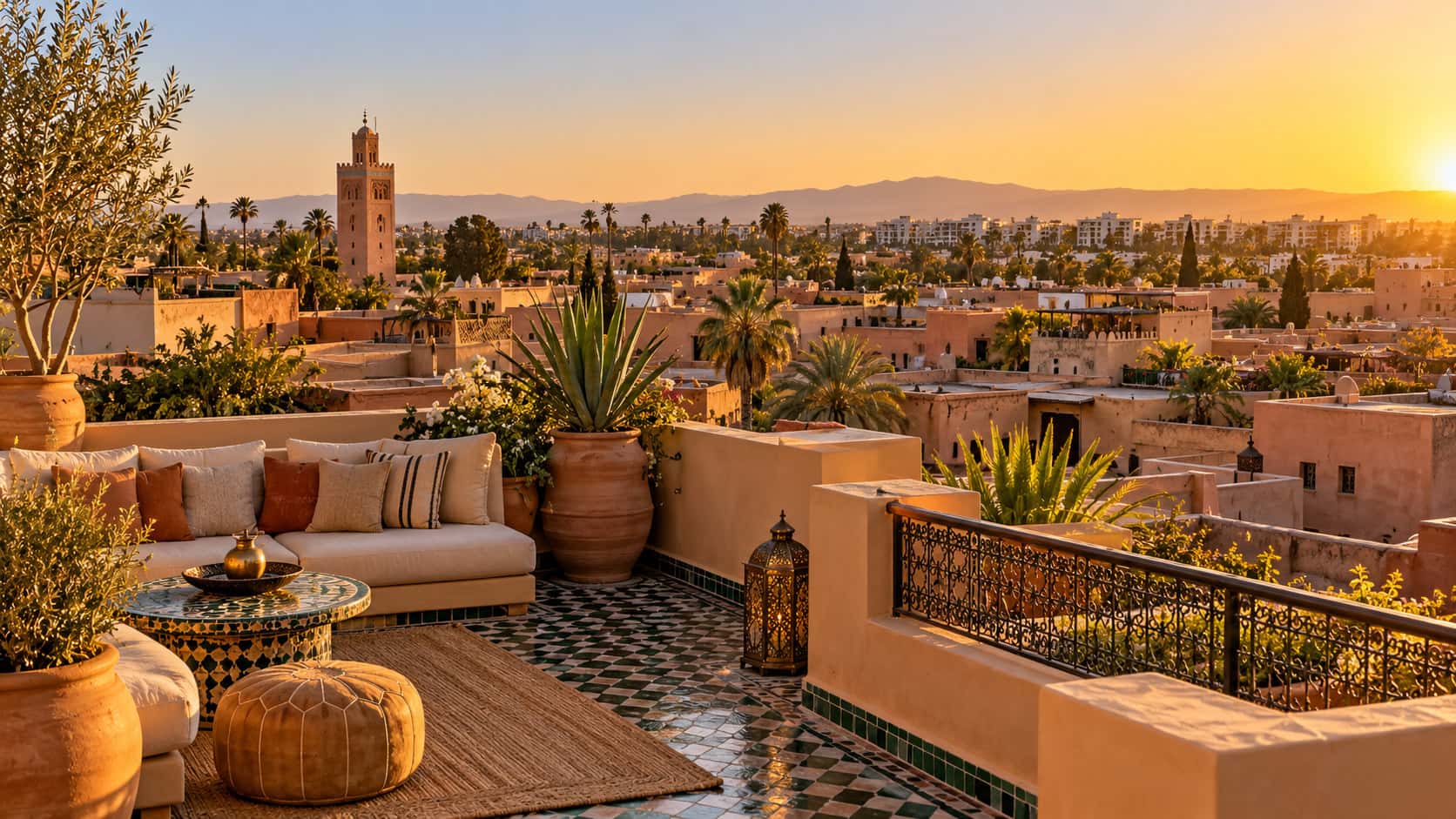
Apartment, Villa or Riad: Which Moroccan Property Fits Your Plan
17 October 2026 · 7 min read · Investment · Morocco
If you are weighing a riad against a villa or an apartment for your Morocco property investment, the right answer depends less on budget and more on how hands-on you want to be, both before you move in and every year after. An apartment is the easiest of the three to buy, finance and let long-term. A villa gives you space and privacy at the cost of running it yourself. A riad gives you the character everyone comes to Morocco for, and the most work of the three, in paperwork, renovation and ongoing management.
We work with buyers in Paris, Brussels, Montreal, London, Madrid and Dubai choosing between all three, often for different reasons: a family home to use twice a year, a flat to let out long-term, or a guesthouse-style project they can show friends. None of the three is objectively better. Each one assumes a different amount of your time, and a different relationship with a notary, a syndic or a property manager once the sale is done.
Here is what actually changes between an apartment, a villa and a riad: what you are legally buying, how new or old it is likely to be, who manages it once you own it, how easily you can let it out, and how easily you can sell it on again.
What You're Actually Buying
An apartment is a unit inside a building you co-own with everyone else living in it. Under Law 18-00, in force since 2002 and amended in 2016, every owner holds a private lot plus a share of the building's common parts, and the building is run by a general assembly of owners and a syndic it appoints. That structure is what pays for the lift, the façade and the shared water tank, and it is also what can slow a renovation down to whatever the other owners agree to.
A villa is a standalone house on its own plot, usually with its own garden and sometimes its own pool, with nothing above or below you belonging to anyone else. Some sit inside a gated development with shared gardens or security, in which case a service charge is set by the developer's own rules rather than by Law 18-00. Most do not, and you deal with the building, the land and the upkeep as one owner, not a committee.
A riad is a traditional courtyard house, usually in the old medina, built around an open-air patio with rooms arranged over two or three floors around it. Many were built long before any modern land registry existed, so a riad is more likely than either an apartment or a villa to still be held on a melkia deed rather than a titre foncier. We set out what that difference actually means for a buyer here, because it changes how carefully the title needs checking before you commit to a specific property.
Buying New or Buying Old
Apartments and villas are the two types most commonly sold off-plan, bought directly from a developer before the building exists, with payments released against construction stages rather than paid in one go. We cover exactly how that VEFA process is meant to protect your deposit here, including what to check before you sign a reservation contract.
A riad is almost never sold off-plan. You are buying an existing, often centuries-old structure, and in the large majority of cases you are also buying a renovation project alongside it, whether the listing calls it "renovated" or not. Budget time as well as money: structural work on a riad usually means lime plaster, timber and traditional materials rather than standard contractor methods, and anything load-bearing or affecting the façade needs sign-off before work starts, with an extra layer of care if the building sits inside a protected part of the medina. Treat the renovation timeline as part of the purchase decision, not an afterthought once you have the keys.
Managing and Letting It Out From Abroad
An apartment is the simplest of the three to manage without being in the country. The syndic already handles the building's common parts, so what is left for you is the inside of your own unit and finding a tenant, or a local agent, to look after that for you. It is also the easiest of the three to let on a standard long lease: demand for a well-located flat in a working city is steadier than demand for a seasonal villa or riad.
A villa needs more active upkeep: a garden, often a pool, sometimes a generator or a borehole if it sits outside the main grid, and none of that cost or hassle is shared with anyone else. That suits either a family that wants space for its own use, or an owner willing to pay a property manager to handle everything a syndic would normally cover in a building.
A riad fits the short-let, guesthouse-style model better than either of the other two, because it is exactly the kind of character property short-stay guests look for and long-term tenants in that city usually are not. Letting it that way means operating as a tourist accommodation in the eyes of the law, not as an ordinary landlord. We cover exactly what licence that requires, and what skipping it costs, here, because a riad is one of the categories the law already names and regulates closely.
Resale and Who Else Wants It
Liquidity runs in roughly the same order. An apartment in a working city has the widest pool of buyers: other investors, local professionals needing a home, and MREs looking for something low-maintenance. A villa appeals to a narrower group, mostly families and lifestyle buyers, and a higher price tag means fewer buyers can act quickly. A riad has the narrowest market of the three: buyers who specifically want a medina project, often other foreigners or hospitality investors, concentrated in a handful of cities where that demand genuinely exists.
None of that makes a riad a bad buy. It means the exit takes longer to plan, and the asking price matters more relative to what comparable riads in that medina have actually sold for, not what a portal lists them at. Our free WhatsApp communities carry real listings city by city, which is the only reliable way to see what comparable property is actually changing hands for, in any of the three categories.
Which One Actually Fits Your Plan
If you want the lowest-maintenance way to own something in Morocco and let it generate income while you are not there, an apartment in a city with steady long-let demand is the simplest match. If you want space for your own family to use and do not mind running it yourself, a villa fits better, especially outside the biggest cities where land and build quality go further for the price. If what you actually want is the Morocco everyone pictures, courtyards, zellige, a rooftop terrace, and you are prepared to manage a renovation and then a hospitality-style letting business, a riad delivers that in a way the other two cannot, at the cost of the most hands-on ownership of the three.
Whichever you choose, the same underlying checks apply: confirm the title before you pay a deposit, cost the ongoing management honestly rather than assuming you will visit more often than you will, and talk to someone who knows the specific city before you fall for one property's photos.
Frequently Asked Questions
It can be, but it is the most demanding of the three to run well. A riad suits buyers prepared to manage a renovation and then a short-let or guesthouse-style business, not buyers looking for the lowest-effort way to own property here. We will not quote a yield, since we do not publish figures we have not verified; our WhatsApp communities carry real asking prices by city if you want to judge a specific property.
Still deciding between the three?
An apartment, a villa and a riad are different businesses to own, not just different price tags. Talk to a consultant who can match the type to your actual plan, city by city, before you commit to one.
Speak to a Consultant