Buying Property in Casablanca: Where the Year-Round Rentals Are
14 September 2026 · 6 min read · Casablanca · Morocco
Buying property in Casablanca is a different exercise from buying on the coast in Marrakech or Agadir. Morocco's largest city runs on salaries rather than seasons: the tenants filling flats in Gauthier or Racine work in the city's banks, ports and head offices twelve months of the year, not just in July and August. The ownership rules are the same as anywhere else in the country. What changes in Casablanca is where the steady, long-let demand actually sits, and which parts of the city are still building the infrastructure to support it.
We work with buyers based in Paris, Brussels, Montreal, London, Madrid and Dubai who are drawn to Casablanca precisely because it does not depend on tourism. This is a guide to the geography, not a pitch for any one building: where the working city rents best, where the coast pulls in a different kind of buyer, and what a newer district under construction actually promises versus what it has already delivered.
None of this replaces a lawyer reading the actual title or a notary running the actual sale. It is the map you need before you bring either of them in.
Why Casablanca behaves differently from a resort city
Casablanca is Morocco's business capital, and the wider region around it reflects that scale: the Casablanca-Settat region counted 7,688,967 people in Morocco's 2024 general census, according to the High Commission for Planning (HCP), the largest of any region in the country. A large share of that population works in finance, shipping, manufacturing and services concentrated inside the city itself.
Part of what anchors that workforce is Casablanca Finance City, the regulated business district built to attract regional and international firms. As of 2026, it counts more than 200 accredited member companies, by its own account, spanning banks, law firms, insurers and multinational regional headquarters. Every one of those firms brings staff who need somewhere to live near the office, all year, which is the demand a coastal resort town simply does not have outside its high season.
Where the long-let tenants are: Gauthier, Racine, Bourgogne and Maarif
Gauthier, Racine, Bourgogne and Maarif form the residential core closest to Casablanca's business districts. These are older, established neighbourhoods of mid-rise apartment buildings, tree-lined streets and a working syndic in most blocks, built up well before the newer developments further out. They house professionals, embassy staff and executives who want a short commute and a flat that does not need explaining to a tenant.
For a buyer abroad, this is the easiest part of Casablanca to manage remotely. Titles are almost always registered titre foncier rather than the older melkia system, buildings have an established management structure, and a straightforward two or three-bedroom apartment rarely sits empty for long because the tenant pool renews itself with the working population rather than a travel calendar.
Ain Diab and the Corniche: the coastal exception
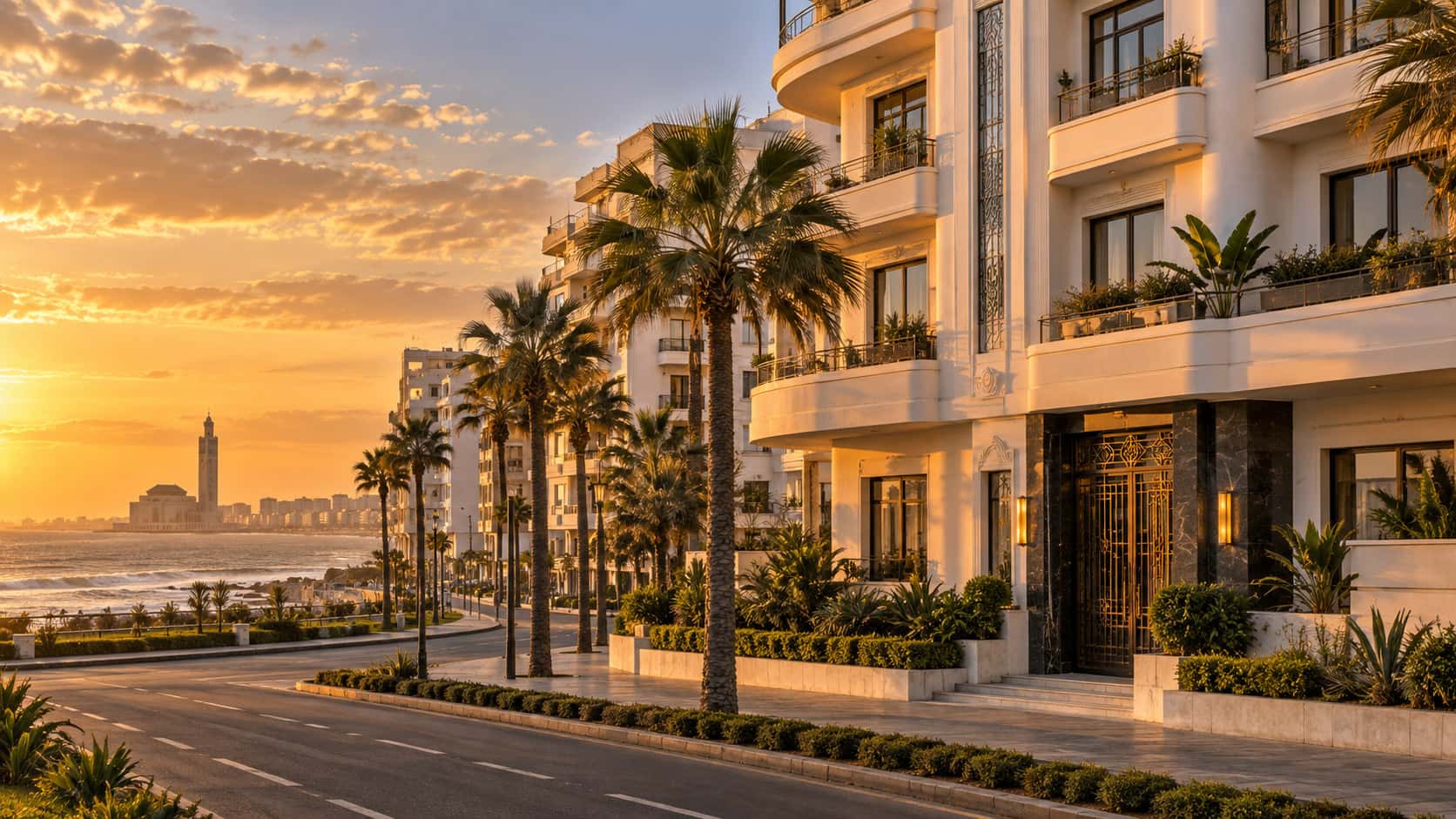
Ain Diab and the Corniche running along the Atlantic are Casablanca's answer to a beach neighbourhood: beach clubs, restaurants and a run of apartment towers and villas facing the water. It is the one part of the city where demand does tilt toward leisure rather than salaries, with weekend and holiday use pulling harder here than in Gauthier or Maarif.
That does not make it a bad buy. It means a buyer should be honest about which market they are in: a Corniche apartment behaves more like coastal property elsewhere in Morocco, busier at weekends and in summer, than like the steady, year-round letting that defines the rest of the city.
Anfa Supérieur and the new Casa Anfa district
Anfa Supérieur is an established, quieter villa district south-west of the centre. Next to it, on the site of the old Anfa airport, Casa Anfa is a new urban centre under construction, run by AUDA, a subsidiary of Morocco's state investment fund CDG. The project covers 350 hectares and is planned to eventually house close to 100,000 residents and around 100,000 workers, alongside offices, shops and a large park, according to CDG's own description of the project.
For a buyer, Casa Anfa means new-build stock with freshly issued titles going up in phases over several years, rather than a finished neighbourhood today. That is the trade-off with any large masterplan: the long-term upside of being early against the reality that some of what is promised on a brochure is still a construction site. Ask any developer selling here exactly which phase your building sits in and what infrastructure around it is actually built, not planned.
The growth belt: Sidi Maarouf, CIL and Bouskoura
Further from the centre, Sidi Maarouf has grown around business parks and office campuses, drawing a newer wave of apartment blocks aimed at staff working nearby. CIL and Oasis sit between the centre and this outer belt, mixing older housing with newer mid-rise developments and offering more space for the price than Gauthier or Racine. Bouskoura, further south again, is where villa compounds and gated developments have spread out, trading a longer commute for a garden and more room.
None of this is better or worse than the centre. It is a different bet: lower entry cost and more space against a longer drive to the office and, in some pockets, buildings and roads that are still catching up with the number of people moving in.
What to check before you commit
- Confirm whether the property carries a registered titre foncier or an older melkia deed, since establishing which one you are dealing with changes how safe the purchase actually is
- Get a full written breakdown of the fees before agreeing a price, since registration duty, land registry charges and the notary's own bill are not optional extras
- For an apartment, ask to see the syndic's accounts and recent minutes, not just the monthly charge, especially in older Gauthier or Racine buildings
- If you plan to let the property while living abroad, check what living outside Morocco changes about the tax owed on a property you hold there before you set a rent
Buying in Casablanca from abroad
The ownership rules do not change depending on which Moroccan city you are looking at: a foreign buyer registers a title in their own name the same way a Moroccan buyer does, with the one exception of land classed as agricultural. What Casablanca adds is a market that rewards patience with the paperwork over excitement about a view, because the buyers who do best here are usually thinking about a tenant who will still be paying rent in February, not just in August.
If you want to see what is genuinely on the market before narrowing anything down, the WhatsApp group where Casablanca's real listings actually surface is a faster way to get a feel for a building or a street than any listing portal.
Frequently Asked Questions
Yes. The same national rule applies here as anywhere in Morocco: a foreign national can register a title in their own name with no residency requirement, except on land classed as agricultural, which needs a reclassification step first.
Want to see what's actually for sale in Casablanca right now?
Listing portals lag behind the real market. Join the free WhatsApp community for Casablanca to see apartments, new-build towers and villas as owners, agents and developers post them.
Join the Casablanca Community