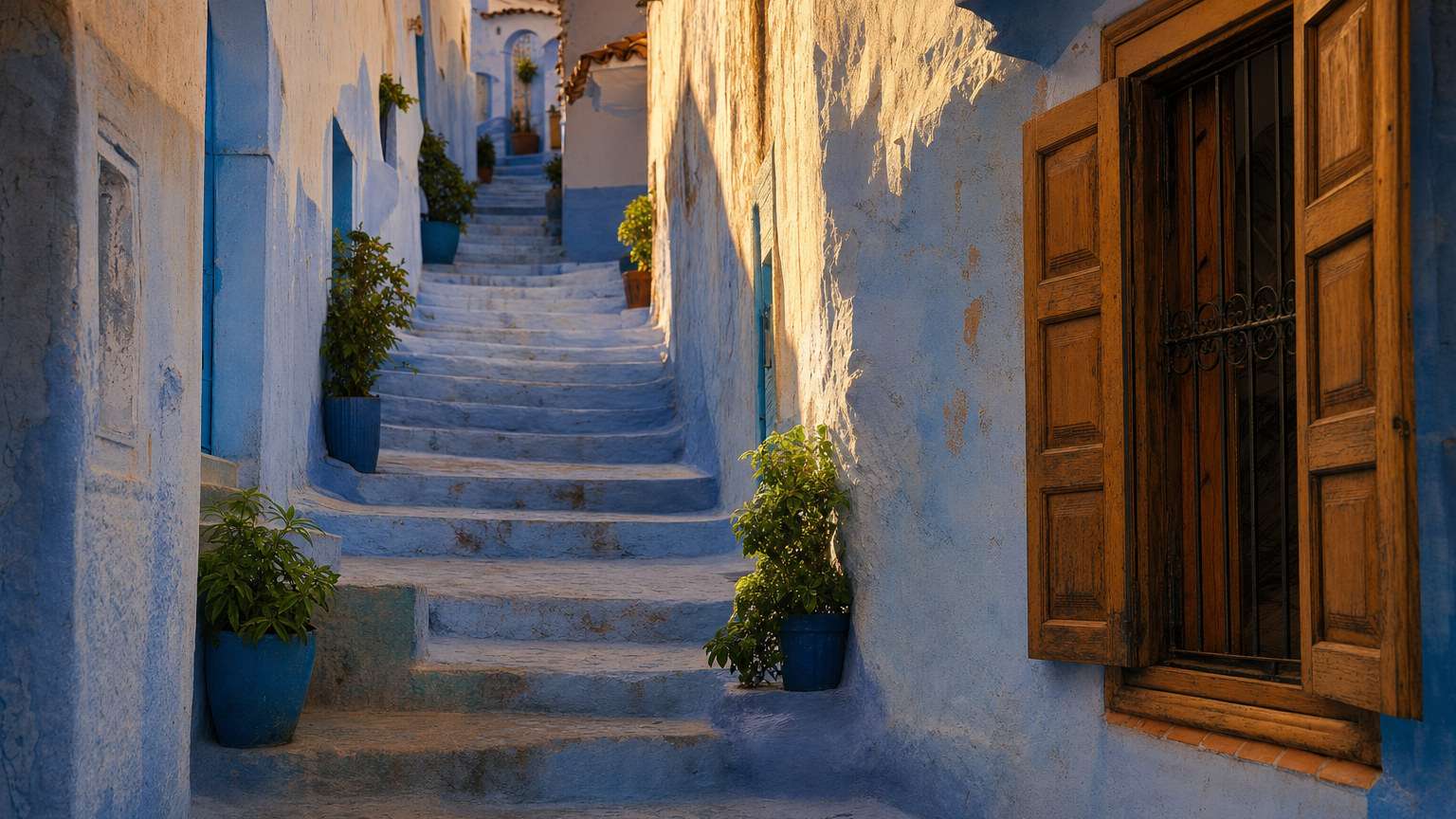
Buying Property in Chefchaouen: The Blue City Beyond the Photos
13 November 2026 · 6 min read · Chefchaouen · Morocco
Buying property in Chefchaouen means buying into Morocco's most photographed town, and a few things set it apart from everywhere else we cover. The ownership rules are the same as for any foreign buyer in Morocco: you can hold full title to a flat, a riad or a guesthouse here exactly as you could in Marrakech or Rabat. What is different is the market underneath the blue walls. Chefchaouen's own population is one of the few in the country where the official count has gone down rather than up over the last decade, and its famous medina carries no UNESCO protection, unlike a handful of Morocco's other old towns.
We work with buyers based in Paris, Brussels, Montreal, London, Madrid and Dubai, and Chefchaouen usually comes up for one reason: a photograph. The blue-washed alleys are among the most shared images of Morocco online, and that pull brings a specific kind of buyer, someone drawn to a single house on a single street rather than to a wider market. That is a perfectly good reason to buy, as long as you are clear-eyed about what you are actually buying into.
None of this replaces a lawyer reading the actual title or a notary running the actual sale. It is the context to bring with you before you call either one in.
A town that went viral, in a province that is losing people
Chefchaouen town pulls tourists from across the world, but the province around it is shrinking, not growing. Chefchaouen province counted 412,713 residents at Morocco's 2024 census, down from 457,432 in 2014, a fall averaging 1.02% a year, the steepest decline anywhere in the Tanger-Tétouan-Al Hoceima region, according to the regional planning directorate's own count. Almost all of that loss is rural: the countryside around the town lost population at 1.32% a year, while the town itself kept growing at 0.87% a year, which is why the province's urbanisation rate climbed from 12.55% in 2014 to 15.18% in 2024 even as the total headcount fell.
For a buyer, the practical read is this: the global fame of the blue medina describes the town, not the region feeding it. A flat inside or just outside the medina walls draws on tourism and the pull of the town itself, not on a fast-growing commuter base the way a coastal suburb of Tangier or Tetouan does. That is not necessarily bad news, tourism demand and resident demand are different things, but treat them as different things rather than as the same growth story told twice.
No UNESCO shield, unlike its neighbours
It is easy to assume otherwise, given how famous the blue streets have become, but Chefchaouen's medina is not on UNESCO's World Heritage List, and it is not currently on Morocco's tentative list either. That puts it in different company from the Medina of Tétouan an hour's drive north, or the medinas of Essaouira, Fez and Marrakesh, all of which carry UNESCO inscription (Wikipedia's list of Morocco's World Heritage Sites, compiled from UNESCO's own published records).
That absence cuts both ways for a buyer. Without a heritage-conservation regime sitting over the old town, renovation and resale inside the medina run through ordinary municipal planning rules rather than a special conservation framework, which in practice can mean a faster, cheaper permit for straightforward repainting or repair work than you would face in a UNESCO-listed medina. It also means there is no extra legal layer stopping a neighbour, or the municipality, from changing something nearby that affects the view or the street you bought into. Ask any agent showing you a medina house what is actually planned for the buildings on either side, because nothing above the ordinary planning process is there to stop it.
The title under the blue paint
As in Morocco's other old medinas, a meaningful share of Chefchaouen's houses were bought and sold for generations before the modern land registry reached them, and so sit on melkia, a traditional deed resting on possession and a documented chain of prior sales, rather than on a titre foncier, the registered title held at the national land registry. Which one a specific house carries changes how safely you can buy it, and it has to be checked house by house. The national ownership rules for a foreign buyer are set once for the whole country and do not vary between Chefchaouen and anywhere else, but what you can actually prove about one specific blue house in one specific alley is a different question entirely, and it is the one that decides whether a sale can complete cleanly.
What a purchase actually costs beyond the price
The asking price for a medina house or a riad is never the full price. Registration duty, the land registry's own fee and the notary's charge all sit on top of whatever figure you agree, and none of them are optional or set by negotiation the way the sale price is. Houses bought to run as guesthouses or short-let riads carry one more line most buyers underestimate: bringing wiring, plumbing and fire safety up to a standard that will pass a tourism inspection, which is a different job from simply making a house liveable for a family.
Letting it out: a one-night town, not a one-week town
Chefchaouen's tourism runs on a shorter rhythm than most of the destinations we cover. A large share of visitors come as a day trip from Tangier, Tetouan or Fez, or stop for one or two nights on a longer loop through the north, rather than booking a week in one place the way visitors to Marrakech or Essaouira often do. That changes what a letting business here actually looks like: turnover is higher, cleaning and check-in costs are a bigger share of revenue, and a property's location within walking distance of the main squares matters more than it would somewhere built around longer stays.
We hold no verified pricing or occupancy data for the town, and both asking prices and achievable nightly rates move block by block, so get current figures from people letting similar properties right now rather than guessing from a single photograph.
Before you sign: the checklist that matters here
- Confirm whether the house sits on a titre foncier or melkia before you agree a price, and use a lawyer who has read medina titles before, not just any Moroccan lawyer.
- Ask directly what is planned for the buildings on either side, since no UNESCO or equivalent rule limits what a neighbour or the municipality can do nearby.
- Run the same resale checks you would run anywhere in Morocco: charges against the property, the real boundaries, and who is actually named on the title, since medina houses often pass through several family hands before they reach a buyer like you.
- If letting is part of the plan, budget for the turnover costs, cleaning, check-in, linen, that a one or two-night town demands more of than a week-long destination does.
Frequently Asked Questions
Yes. Ownership rules for a foreign buyer are set nationally and [do not change by town](/blog/can-foreigners-buy-property-in-morocco/). What is specific to Chefchaouen is the title itself and the absence of any heritage-conservation regime over the medina, both of which need checking house by house rather than assumed from the fact that a sale is going ahead.
Want to see what's actually for sale in Chefchaouen right now?
Listing portals barely cover the medina. Join the free WhatsApp community for Chefchaouen to see riads, guesthouses and medina houses as owners, agents and developers post them.
Join the Chefchaouen Community