Buying Property in Dakhla: The Far South, Honestly
21 November 2026 · 7 min read · Dakhla · Morocco
Buying property in Dakhla means buying into a city that has little in common with the rest of Morocco's property market: a peninsula town on a vast lagoon in the far south, a deep-water port under construction a few kilometres away, and a land registry and planning system still catching up with how fast the place has grown. The national ownership rules for a foreign buyer are the same ones that apply anywhere else in the Kingdom. What is different is how new most of the city's growth is, and how little verified data exists to check a price against.
We work with buyers based in Paris, Brussels, Montreal, London, Madrid and Dubai, and Dakhla comes up for a specific reason: either a return visit after a kitesurfing trip, or interest in the port and the wider southern provinces development push. This guide sets out what is actually happening in the city and what to check before any of it, not a pitch for one project over another.
None of this replaces a lawyer reading the actual title or a notary running the actual sale. Given how recently much of Dakhla's land has moved from open desert or informal use to registered plots, that step matters more here than in a city with a longer paper trail.
Who lives in Dakhla, and how new the city is
The Dakhla-Oued Ed-Dahab region counted 219,965 residents at the 2024 census, according to Morocco's statistics authority, the Haut-Commissariat au Plan (HCP), from a count carried out between 1 and 30 September 2024. That is a small population spread across a huge, largely desert region, and the city of Dakhla itself, built on a narrow peninsula jutting into the Atlantic, holds the great majority of it. A generation ago this was a small garrison and fishing town. What exists today, the hotels, the kite camps, the new residential blocks, has mostly been built since the 2000s, which is worth remembering every time a seller describes a building as "established" or a neighbourhood as "developed."
The lagoon: kitesurfing, oysters and competing land uses
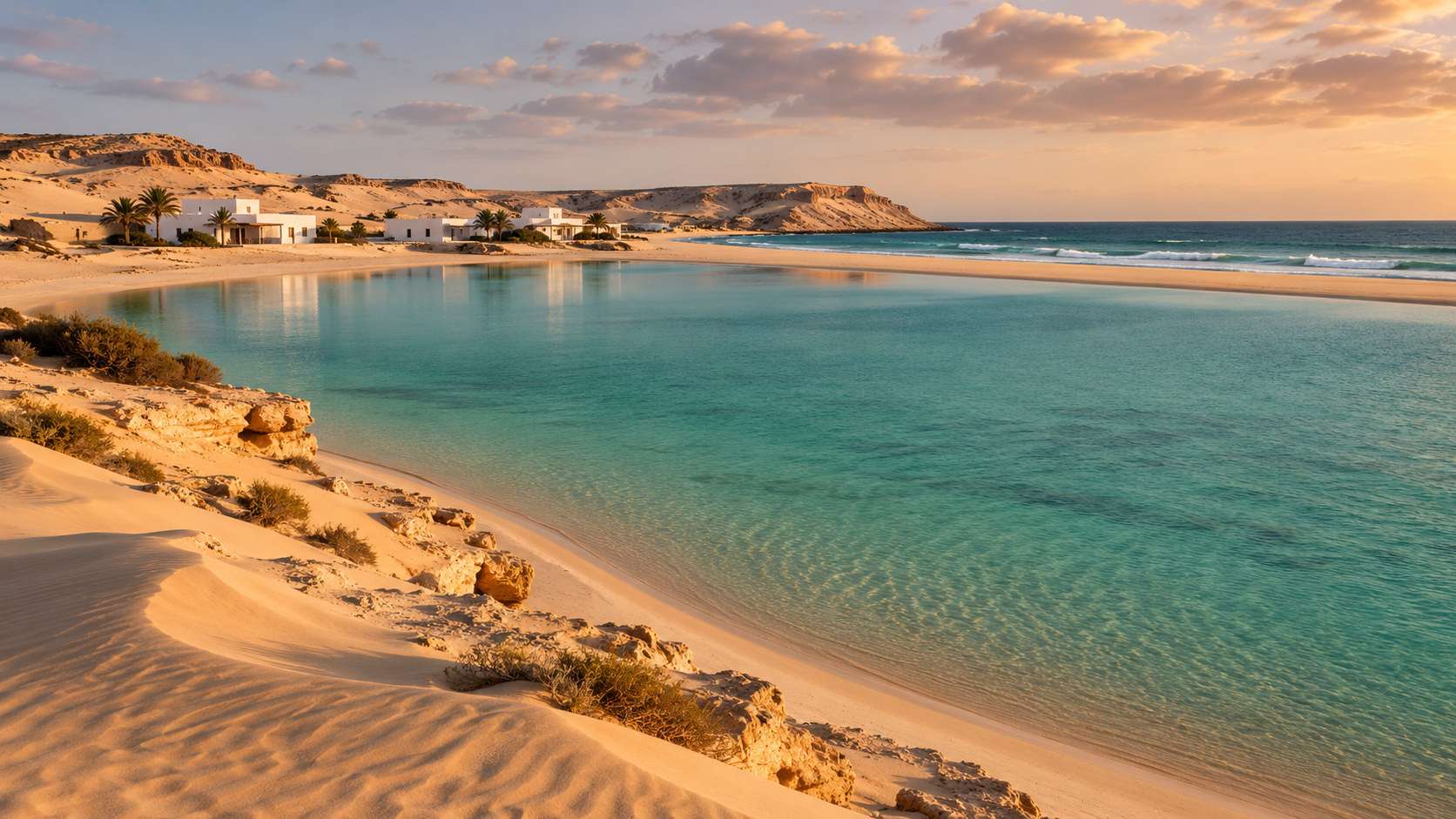
Dakhla's lagoon, a long sheltered bay separated from the open ocean by a sandbar, is the reason most people have heard of the city at all. It has become one of the world's best-known kitesurfing destinations, with wind reliable enough that camps line the northern shore, and it supports a genuine local oyster-farming industry along its edges. Those two things, water sports and aquaculture, sit in direct tension with a third: real estate development right up to the water. Local officials have described real estate pressure on the lagoon as high, with hotels and residential plots competing for the same shoreline that tourism and shellfish farming depend on staying clean and undeveloped.
For a buyer this matters in a practical way. A plot advertised as "lagoon-front" may sit inside an area with its own environmental or planning constraints, and the authorities weighing tourism, aquaculture and construction against each other have not finished doing so. Ask specifically what the land is zoned for and whether any part of the shoreline in question is protected, rather than assuming a view of the water means a straightforward build.
A new national park covers most of the region
In December 2025, Morocco's National Agency for Water and Forests (ANEF) announced the creation of the Dakhla-Oued Ed-Dahab National Park, covering roughly 1.9 million hectares of coastal zones, desert and wetland across the region. A protected area on that scale does not stop the city itself from growing, but it is a reminder that land classification around Dakhla is actively being redrawn. If you are looking at a plot anywhere near the lagoon's edges, the open desert beyond the urban perimeter, or any area described as undeveloped, confirm its exact zoning and protection status before you treat it as a normal residential purchase.
Port Dakhla Atlantique: the project reshaping the city's prospects
A few kilometres from the city, construction is under way on Port Dakhla Atlantique, a deep-water port and adjoining industrial zone meant to give Morocco a logistics gateway to West Africa. Le360 reported in June 2026 that overall progress on the works stood at 62%, with the sea bridge connecting the port to the mainland at 85% and full delivery still targeted for the end of 2028, the project's original deadline.
A port of this scale, built from scratch rather than expanded, tends to bring staff, contractors and logistics workers who need housing for years rather than a season. It is too early to call that a rental market: the port has not opened yet, and the city's existing rental demand is still dominated by tourism and kitesurfing seasons. Treat any claim that the port has already pushed up property demand or prices as a sales pitch rather than a fact, and ask in the local community what is actually happening before you act on it.
What to check before you buy in Dakhla
- Confirm the title status of the specific plot, since the difference between a registered titre foncier and an older melkia deed matters everywhere in Morocco but especially on land that has only recently been brought into the city's urban perimeter.
- Ask directly whether the plot or building sits inside, or close to, the new Dakhla-Oued Ed-Dahab National Park or any other protected or reclassified zone, and get that in writing from the seller, not just a verbal assurance.
- Get a full written breakdown of registration duty, land registry charges and the notary's fee before you agree a price, since none of them are built into a listing's asking figure.
- Treat any price near the lagoon, the port, or described as benefiting from "port growth" as a starting point for negotiation, not a benchmark. We hold no verified pricing data for Dakhla, so ask in the local WhatsApp community what comparable properties have actually sold for.
- Run the same resale checks you would anywhere else in Morocco, utility connections, outstanding service charges, boundary accuracy, since a market growing this fast attracts sellers who are less careful with paperwork than the title itself requires.
Buying in Dakhla from abroad
The national ownership rules do not change from one Moroccan city to the next: a foreign buyer registers a title in their own name in Dakhla exactly as anywhere else in the Kingdom, with the usual exception for land classed as agricultural. Given how much of the land around Dakhla sits in categories, desert, coastal, newly urbanised, that do not map neatly onto a city buyer's usual due diligence, running the full resale checklist before you commit is worth the extra week it takes.
Frequently Asked Questions
Yes. Ownership rules for a foreign buyer are set nationally and apply in Dakhla exactly as they do in Rabat or Casablanca, with the usual exception for land classed as agricultural. Given how recently much of the city's land has moved into urban use, pay particular attention to confirming a plot's exact classification before you commit.
Want to see what's actually for sale in Dakhla right now?
Listings for Dakhla are thin on the portals and often out of date. Join the free WhatsApp community for Dakhla to see flats, plots and villas near the lagoon as owners, agents and developers post them.
Join the Dakhla Community