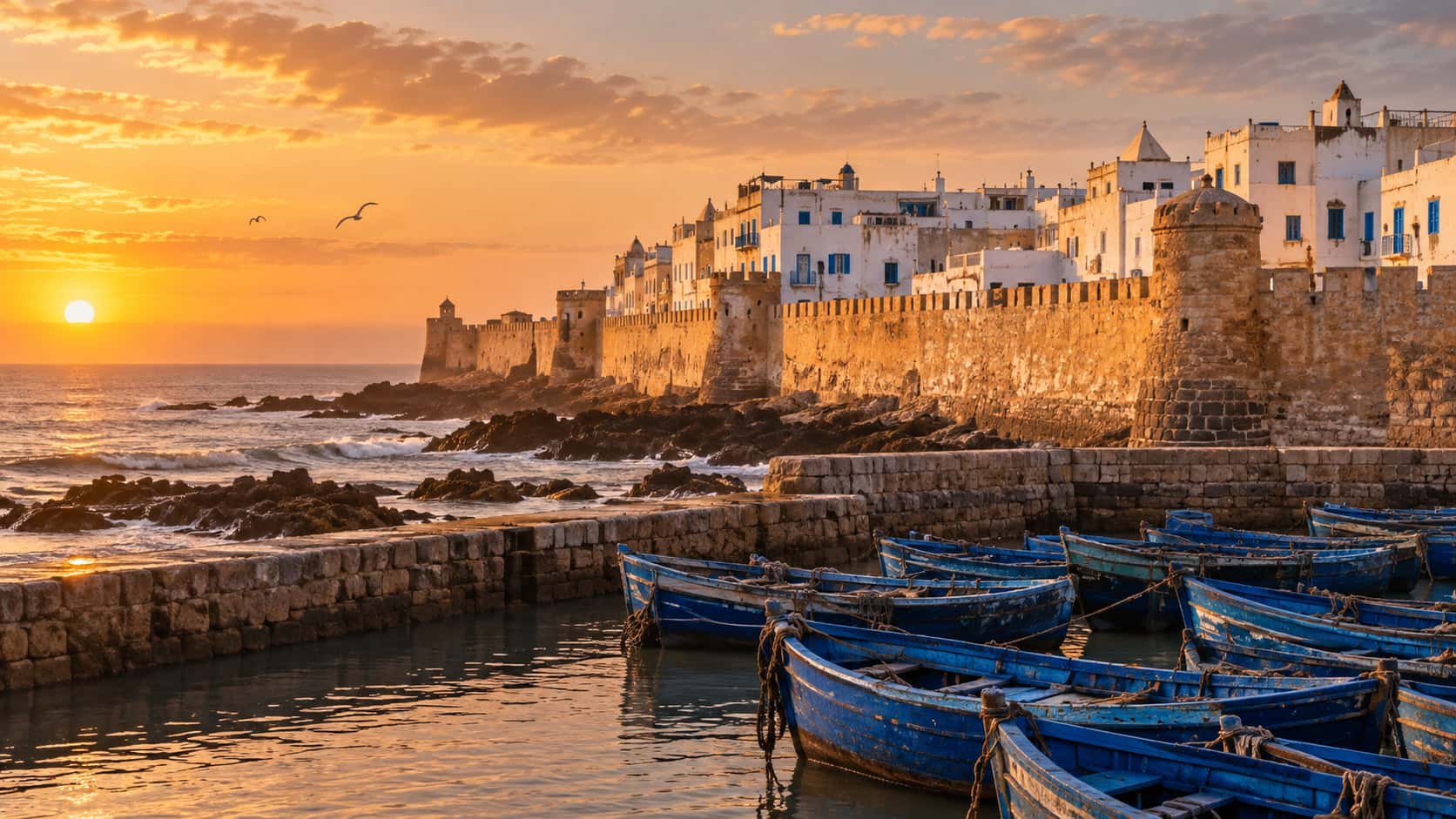
Buying Property in Essaouira: Wind, Riads and Rental Seasons
15 October 2026 · 6 min read · Essaouira · Morocco
Buying property in Essaouira means choosing between two different markets that happen to share a postcode: a UNESCO-listed medina of riads and courtyard houses that holds its value because nobody is allowed to change it much, and a windswept coastline where demand runs on tourist seasons rather than on people who live there all year. The ownership rules for a foreign buyer are the same here as anywhere in Morocco. What is different is what you are actually buying and who, realistically, will want it after you.
We work with buyers in Paris, Brussels, Montreal, London, Madrid and Dubai, and Essaouira comes up for a specific reason: it is the one Moroccan coastal town that built its reputation on wind rather than sun. That reputation decides almost everything about the local property market, from which houses rent well to which ones sit empty between festivals.
None of this replaces a lawyer reading the actual title or a notary running the actual sale. It is the context to bring with you before you call either one in.
A medina that cannot be redeveloped, which is the point
Essaouira's old town, inscribed by UNESCO as the Medina of Essaouira (formerly Mogador), was added to the World Heritage List in 2001 under criteria recognising it as a well-preserved late 18th-century fortified seaport, laid out along European military architecture of the period and adapted to a North African setting (whc.unesco.org). That listing is why the ramparts, the narrow grid of streets and the riad facades behind them cannot be knocked through or built over the way property elsewhere in Morocco sometimes is.
For a buyer, that protection cuts both ways. It is a large part of why medina riads hold buyer interest year after year: the setting cannot be duplicated on the coast outside it, and no developer can build a competing block of flats two streets over. It also means renovation work inside the walls runs through conservation rules rather than a standard building permit, so a riad that looks like a straightforward restoration project can take longer and cost more to finish than the same square metreage would elsewhere. Budget for that delay before you buy, not after the first contractor's quote.
Medina riads often sit on an older kind of title
A large share of medina property in Essaouira, as in Morocco's other historic medinas, was never through the modern land registration process and so sits on melkia, a traditional deed, rather than on a titre foncier, the registered title that gives the strongest legal protection. The difference between the two changes how safely you can actually buy a specific house, and it has to be checked house by house, not assumed from the fact that a sale is going ahead. The national ownership rules for a foreign buyer do not vary by city or by title type: they are set once for the whole country, but what you can actually prove about the specific riad in front of you is a separate question entirely.
Outside the walls: a coastline built for wind
Step outside the ramparts and the market changes character completely. The town's steady Atlantic trade winds, known locally as the alizés, turned Essaouira into one of Morocco's best-known windsurfing and kitesurfing destinations decades ago, and that reputation still shapes who visits and when. South of the medina, Diabat and the dunes toward Sidi Kaouki have built a smaller, quieter rental market around the same wind, aimed at a longer-stay, more specialist crowd than the day-trippers who fill the medina in summer.
That wind-driven demand is a genuine asset, but it is a narrower one than it looks. A kitesurf school's season and a family's August holiday are not the same calendar, and a coastal property built for one will not automatically fill for the other. Treat any coastal plot or new-build apartment here as a bet on a specific type of visitor, not on "the coast" in general.
The practical difference shows up fastest in construction standards. A new-build apartment block near the beach has to be built to handle salt air and constant wind-driven sand, which is a different maintenance conversation to the one you would have about a riad's interior courtyard. Ask any agent or developer what the building's exterior finish is rated for before you commit, because repainting or re-rendering a windward facade every few years is a real recurring cost, not a hypothetical one.
What a purchase actually costs beyond the asking price
Whether you are buying a medina riad or a coastal apartment, the price you negotiate is not the price you pay. Registration duty, land registry fees and the notary's own charge sit on top of whatever figure you agree, and none of them are optional or negotiable in the way the sale price is. Riad purchases carry one extra line that a standard apartment sale does not: a proper survey of the structure itself, because old timber, plumbing and electrics behind a restored facade are exactly the kind of thing a viewing does not show you.
Before you sign: the checklist that matters here
- Confirm whether the property sits on a titre foncier or on melkia before you agree a price, and use a lawyer who has specifically read medina titles before, not just any Moroccan lawyer.
- Run the same due diligence you would run on any resale: charges against the property, the real boundaries, and who is actually named on the title, since riads frequently change hands within extended families before they ever reach a buyer like you.
- Get a structural survey on any riad, inside the walls or not. A beautiful tadelakt finish tells you nothing about the roof terrace drainage or the state of the beams underneath it.
- Separate the two markets in your own head before you negotiate: a medina riad competes on heritage and scarcity, a coastal plot competes on wind and season. Pricing logic that works for one will mislead you on the other.
Letting it out: a town that runs on two very different seasons
If letting the property is part of the plan, be precise about which Essaouira you are renting into. The medina pulls a steady trickle of visitors most of the year, built around the old town itself rather than a single season, while the kite and surf coast outside it runs on a narrower window tied to wind conditions and school holidays. The rules that govern short-term letting apply the same way here as anywhere else in Morocco, but the occupancy pattern they are applied to is genuinely different house by house. We hold no verified pricing or yield data for either market, and asking prices move by street and by season, so get current figures from people letting similar properties right now rather than from an average that will not hold.
Frequently Asked Questions
Yes. Ownership rules for a foreign buyer are set nationally and [do not change by city](/blog/can-foreigners-buy-property-in-morocco/). What changes in Essaouira specifically is the title itself: a larger share of medina property sits on melkia rather than a registered titre foncier, so that needs checking before you commit to a price.
Want to see what's actually for sale in Essaouira right now?
Listing portals lag behind the real market here, especially inside the medina. Join a free WhatsApp property community to see riads, medina houses and coastal plots as owners, agents and developers post them.
Join a Property Community