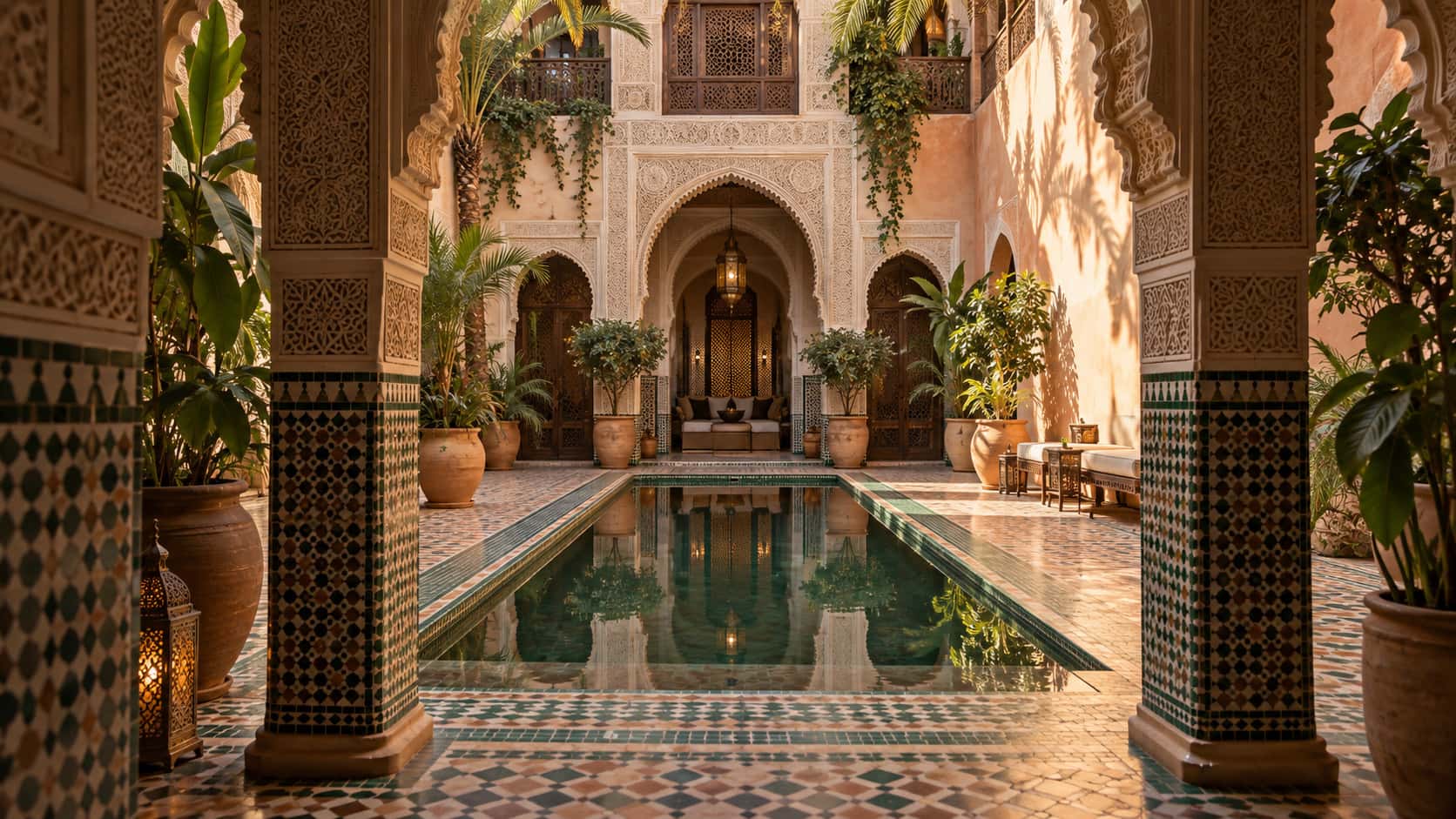
Buying Property in Marrakech: Neighbourhoods, Riads and What to Check
11 September 2026 · 6 min read · Marrakech · Morocco
Buying property in Marrakech follows the same national rules as anywhere else in Morocco: a foreigner can register a title in their own name, with no residency test attached to it. What differs from city to city is what you are actually looking at when you say yes. Marrakech is really two or three property markets wearing one name: a walled medina of courtyard houses on titles that sometimes predate the modern land registry, a French-built new town of apartment blocks and offices, and a ring of villa compounds and newer developments spreading out from both.
We work with buyers based in Paris, Brussels, Montreal, London, Madrid and Dubai who know they want Marrakech long before they know which part of it. This is the geography and the practical checks, not a pitch for any one neighbourhood: where the medina, Gueliz, Hivernage, Agdal and the Palmeraie differ, and what each one asks of a buyer who cannot pop round to check on things.
None of this replaces a lawyer reading the actual title or a notary running the actual sale. It is the map you need before you bring either of them in.
The medina: riads and the title question
The medina, the walled old city, has been continuously inhabited since the 11th century and was inscribed as a UNESCO World Heritage Site in 1985, recognised for its ramparts, palaces, mosques and the ordinary riad houses still lived in behind its walls, according to UNESCO's own listing. That history is not just a backdrop. It is part of why so many medina riads sit on titles that were never modernised.
Some medina riads carry a titre foncier, a title registered at the national land registry. Others are still held under melkia, an older form of ownership resting on possession rather than a central register, and the difference between the two decides how safe a purchase actually is. Establish which one you are dealing with before you fall for the courtyard or the zellige.
Buying an unrenovated riad also means budgeting for structural work you cannot fully judge over a video call: load-bearing walls shared with neighbouring houses, old roof terraces, plumbing run decades ago. Use an architect who has actually worked inside the medina before, not a generalist, and get them into the property before you agree a price.
Gueliz and Hivernage: the new town
Gueliz is the part of Marrakech the French protectorate built outside the walls from 1913 onward, with wide boulevards and a street grid instead of a maze. It holds most of the city's offices, restaurants and apartment blocks today, and it is the easiest part of Marrakech to buy into from abroad: modern buildings, registered titles, and a managing syndic for shared costs and repairs.
Hivernage sits just south of Gueliz, closer to the Menara exhibition grounds, and leans toward villas, hotels and gated apartment residences rather than the working city further into Gueliz itself. Both areas suit a buyer who wants a documented, straightforward purchase rather than a restoration project.
Agdal, Semlalia and the residential belt
Agdal and Semlalia sit further out again, mostly residential, mostly Moroccan families and long-term residents rather than tourists. Housing runs from older apartment blocks to newer mid-rise developments, with schools, clinics and everyday shops built in around them. If your plan is to live in the property full time, or let it long-term to a resident family rather than short-stay guests, this is the part of the city worth walking before you rule it out in favour of something more photogenic.
The Palmeraie and the villa belt
North-east of the city, the Palmeraie is Marrakech's historic palm grove and the villa compounds and golf developments built through and around it over recent decades. Plots here are larger, walls are higher, and privacy is the point. Because parts of the Palmeraie are genuinely agricultural land rather than an urban extension, some of it falls under the separate rules that apply to a foreign buyer on agricultural land, and needs the same reclassification step as any other agricultural plot before a foreign buyer can hold it. Check this before you commit to a particular plot, not after.
Newer growth areas
Marrakech has also grown well beyond its historic footprint, with developments along the roads to Fes, Casablanca and the airport, and newer residential zones on the city's southern and eastern edges. This is mostly where off-plan stock sits: apartment blocks and small villa projects sold before completion. The trade-off against the medina or Gueliz is straightforward, less character and a longer wait, against a modern build with a freshly issued title and no restoration to manage.
What to check before you commit
None of this changes with the neighbourhood. What changes is how much of it needs doing before you sign, and how much can safely wait until after.
- Ask whether the title is a titre foncier or a melkia, and get a lawyer to verify it at the land registry rather than trusting a photocopy
- Get a full written breakdown of registration duty, land registry fees and the notary's own charge before you agree a price, since none of them are optional
- For an apartment or a villa inside a residence, ask to see the syndic's accounts and any planned works, not just the monthly charge
- For a riad, get a medina-experienced architect to walk the property before you commit, not after
Buying from Marrakech, from abroad
The national rules on who can buy are the same wherever in Morocco you look: a foreign buyer registers a title in their own name the same way a Moroccan buyer does, with the one exception of agricultural land. What Marrakech adds is choice, and choice is where buyers working from photos and a video call tend to make mistakes.
If you want to see what is genuinely on the market before you narrow anything down, Marrakech's own WhatsApp property community posts real listings from owners, agents and developers every day, which is a faster way to get a feel for a neighbourhood than any listing portal.
Frequently Asked Questions
Yes. The same national rules apply as anywhere in Morocco: a foreign national can register a title in their own name with no residency requirement, except on land classed as agricultural, which needs a reclassification step first.
Want to see what's actually on the market in Marrakech?
Listing portals lag behind what's really for sale. Join the free WhatsApp community for Marrakech to see medina riads, Gueliz apartments and new-build villas as owners, agents and developers post them.
Join the Marrakech Community