Renovating a Riad in Morocco: Permits, Budgets and Patience
12 November 2026 · 8 min read · Legal · Process
Renovating a riad in Morocco runs on two separate permit systems, not one, and that is before you decide whether you will ever let a stranger sleep in it. One system governs what you are allowed to do to the physical building. A second, entirely different one applies on top of it the moment you plan to operate the finished riad as a guesthouse rather than live in it yourself.
Most of what gets written about this online is a vague warning to "expect delays and expect to pay a fiscaliste." That is not wrong, but it is not useful either. The actual rules that decide how long your project takes and which office signs off on it are written down, in the construction regulation and the tourism law, and they draw clear lines between a cosmetic refresh, a structural renovation and a conversion into a business.
This piece sets out those lines, what they mean for your timeline and budget, and the two things worth checking before a single wall comes down.
Check the title before you touch a wall
A riad bought in an old medina is one of the properties most likely in Morocco to sit on a melkia deed rather than a titre foncier, the registered title held at the national land registry. We cover the difference between the two in detail elsewhere, but the short version matters here specifically: Moroccan banks generally want a mortgage registered against a definitive titre foncier, so a melkia-only riad is much harder to finance, including financing the renovation itself. If you are counting on a loan to pay for the works, find out which deed you are dealing with before you price the job, not after.
This sits alongside the wider checks any resale property needs, which we set out separately: confirming who can actually sign off on the sale, what charges already sit against the property, and whether the boundaries on paper match what you are buying. A riad that has passed down through a family for generations often has more than one of these questions attached to it at once.
Three different permits, and which one your project actually needs
Morocco's construction rules are set out in the règlement général de construction, approved by Décret n° 2-18-577 of 12 June 2019, which applies the urbanism law passed by the dahir of 17 June 1992. As of 2026, it still splits renovation work into three tracks, and which one applies decides most of your timeline.
Minor work on an existing building, the kind listed in the regulation's own annex, needs no building permit at all under Article 20: repainting, small fixes, work that does not touch the structure. A genuine renovation of an existing building, one that goes beyond that but stops short of a structural rebuild, falls under Chapter II of the same regulation: the "permis de réfection relatif aux bâtiments existants." That file goes straight to the commune's own planning department, which has five working days to decide and must issue the permit within ten working days of filing, under Articles 45 and 46, without needing sign-off from the Agence Urbaine or any other sectoral body. The catch is Article 47: that permit is valid for six months only, and it cannot be renewed.
If the work changes the structure, extends the building, or is substantial enough to count as a "grand projet" under the regulation, you are in a different process entirely. The file goes to a commission that includes the commune, the province and, critically, the Agence Urbaine, whose opinion the commune cannot overrule under Article 39. Under Article 18, that commission has 15 working days to rule once the commune has forwarded the file, which it must do within three working days of receiving it. Knocking through load-bearing walls, adding a floor, or combining two riads into one almost always lands here, not in the faster réfection track.
If you plan to let it out, there is a second system entirely
Operating a renovated riad as a guesthouse is not covered by the construction permit on its own. Loi 80-14 defines "riad" in law, under Article 3, as a house characterised by traditional Moroccan architecture and decoration that provides lodging, and treats it as a recognised tourist establishment type alongside maisons d'hôtes and kasbahs. Under Article 4, any project that converts an existing building into one of these establishments must meet a specific construction regulation covering dimensions, safety, hygiene, energy efficiency and water use, and the building permit itself cannot be granted unless the plan meets those standards. Under Article 5, you then need a separate operating authorisation, which is only granted once the property has a provisional classification and you have taken out the insurance the law requires. A further exploitation classification follows a visit from a regional commission once the riad is actually open, under Article 6, and the operator has sixty days from opening to notify the authorities.
That whole system changed shape in 2025. Five ministerial orders published that June moved riads, maisons d'hôtes and kasbahs onto a star-rating system built with UN Tourism, checked partly through unannounced "mystery visits," with classifications reassessed every five to seven years rather than granted for good. Existing operators were given 24 months to comply. We go through the licensing rules for short lets, and what skipping them costs, in a separate piece, since the fines sit in the same law and apply whether the property is a riad or an ordinary flat.
Why old riads blow through the first estimate
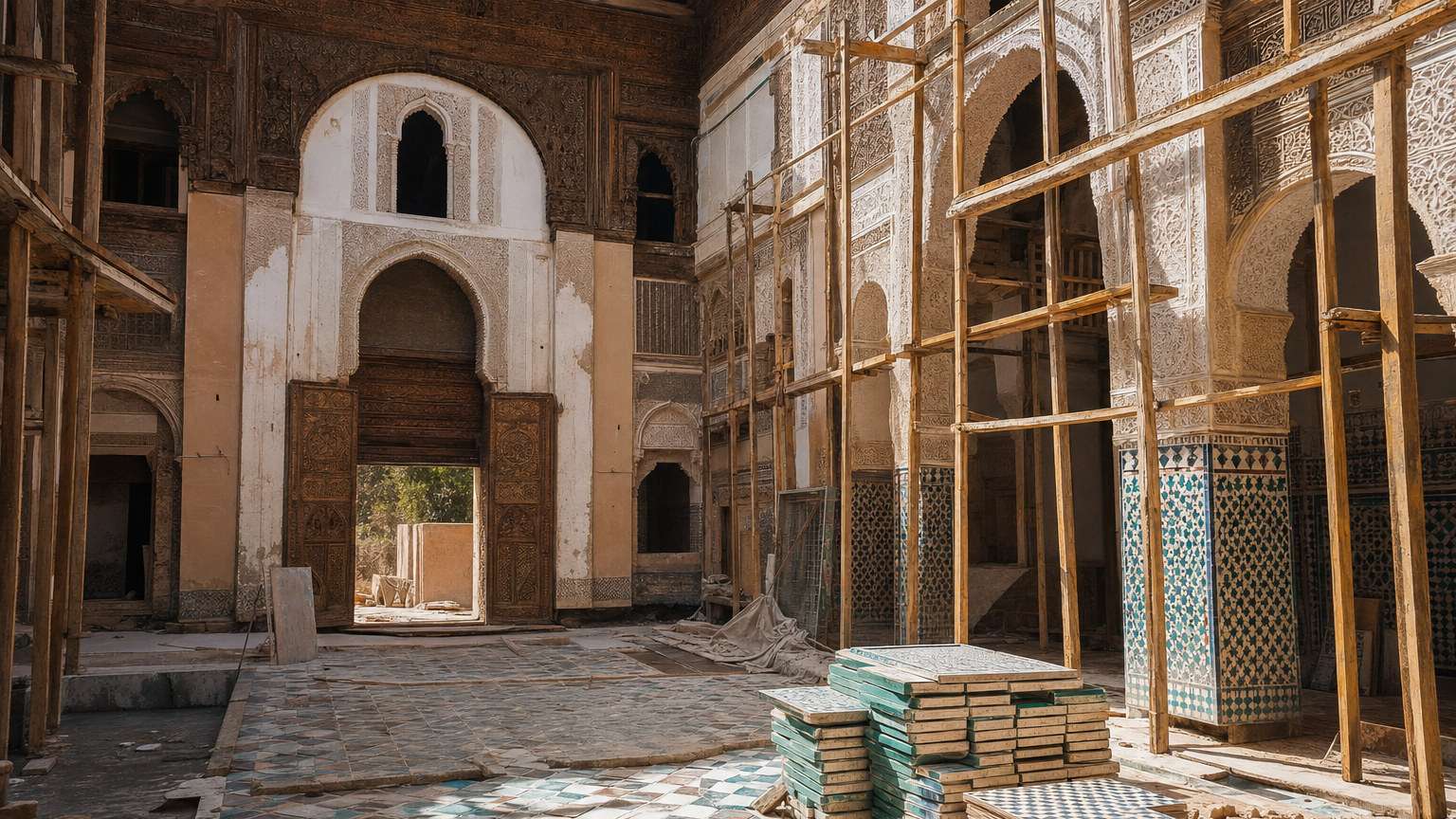
A medina riad is built around a courtyard, with load-bearing walls shared with the houses on either side and a structure that, behind the plaster, is usually a mix of rammed earth, fired brick and timber rather than poured concrete. A visual inspection before the sale tells you very little about the state of that structure. The real condition only shows once a wall is opened, and it is common for a renovation to reveal rot in a timber beam, damp rising through an earth wall, or a neighbour's wall bearing more load than anyone realised.
The medina itself adds its own delay. Most lanes are too narrow for a lorry, so materials and rubble move by handcart or small vehicle, which slows every delivery and every skip. None of this is a reason to walk away from an old riad. It is a reason to treat any first quote as a starting point rather than a number, and to build in time for the building to tell you what it actually needs once the work starts.
Budgeting for what the quote cannot see
Before you commit to a figure, pay for an architect or structural survey to look behind the plaster where it is possible to do so, rather than relying on a general contractor's walk-through. Keep a genuine, untouched reserve for what that survey cannot catch, since in a building this old something usually turns up once the first walls come down. If money is tight, phase the work room by room rather than opening the whole courtyard at once, so a bad surprise in one corner does not stall the entire project.
Price the specialist trades separately from the general build. Zellige setting, tadelakt plastering and carved gypsum work are skills a general contractor will usually subcontract and mark up, and the quality gap between a specialist and a generalist doing the same job is large enough to see with your own eyes once it is finished.
Finding people who have actually restored one before
A riad is not a villa, and the skills that keep a modern build on schedule are not the same ones that know how to repair a century-old earth wall without weakening it further. Look for a maalem, a master craftsman, with riad-specific experience rather than a general contractor who has only built new. Ask to see a finished job in the same medina if you can, since the materials and the problems repeat from one riad to the next in the same city.
If you are not in Morocco to vet anyone yourself, decide in advance who is authorised to approve a change in scope or release a payment, rather than finding out only after money has already moved. The WhatsApp community for your city is a reasonable place to ask other owners who they actually used, before you commit to anyone based on a single quote.
Frequently Asked Questions
It depends on the scope. Minor, non-structural work needs no permit at all. A genuine renovation of the existing building needs a "permis de réfection relatif aux bâtiments existants," issued by the commune within ten working days and valid for six months. Structural work, extensions, or converting the riad into a business needs the full permit process, which requires the Agence Urbaine's sign-off.
Renovating a riad you bought from abroad?
Every one of these permits is filed in person, in French or Arabic, at a commune or an Agence Urbaine you may never visit yourself. Talk to a lawyer who files these authorisations for a living before you sign a contractor.
Speak to a Lawyer