Buying Property in El Jadida and Mazagan: The Atlantic Alternative
19 October 2026 · 6 min read · El Jadida · Morocco
Buying property in El Jadida means choosing between three different markets that sit inside one town: a Portuguese fortress old enough to carry UNESCO protection, a golf and resort coast built for second homes, and a working port city that quietly absorbs people priced out of Casablanca. The ownership rules for a foreign buyer are the same here as anywhere else in the country. What changes is which of those three markets you are actually buying into, and each one behaves differently.
We work with buyers in Paris, Brussels, Montreal, London, Madrid and Dubai, and El Jadida tends to come up for one of two reasons: either someone wants the coast without Agadir's crowds and Essaouira's wind, or someone already looking in Casablanca realises how far their budget stretches an hour down the road.
None of this replaces a lawyer reading the actual title or a notary running the actual sale. It is the context to bring with you before you call either one in.
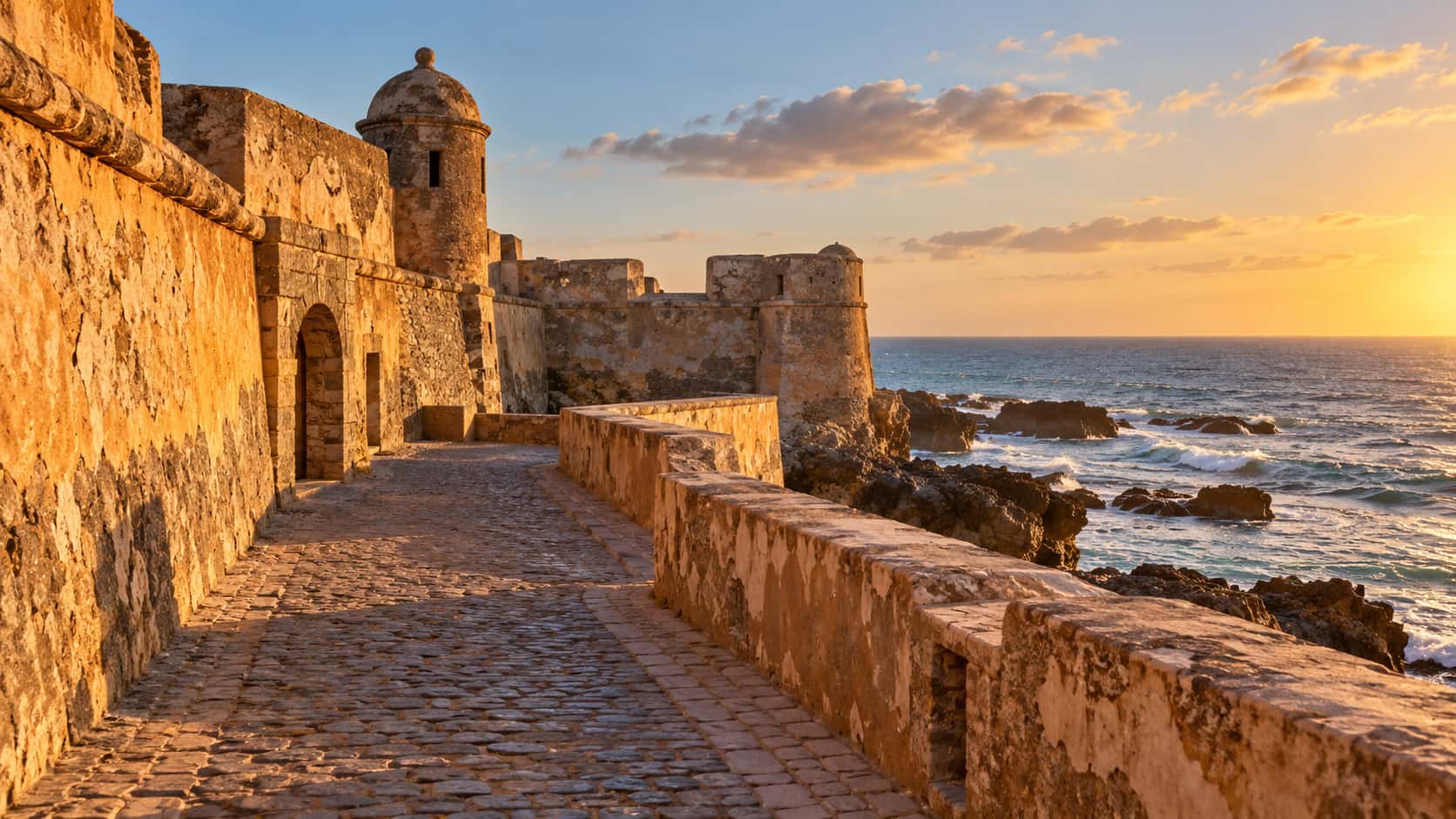
Mazagan: a Portuguese fortress inside a working Moroccan town
El Jadida's old town was built by the Portuguese in the early 16th century as the fortified port of Mazagan, and it stayed under Portuguese control until 1769. UNESCO inscribed the Portuguese City of Mazagan as a World Heritage Site in 2004, citing it as an outstanding example of the interchange between European and Moroccan cultures in early modern military architecture and town planning (whc.unesco.org). The walls, the bastions and the Portuguese cistern underneath the old town are the reason people visit; the modern commercial town that grew up around them, confusingly also called El Jadida, is where most of the actual buying and selling happens.
That protected status is a genuine asset for a buyer with the patience for it. A listed fortress cannot be built out or redeveloped around, so the setting inside the walls is permanent in a way that new-build coastline rarely is. It also means any renovation inside the ramparts runs through heritage rules rather than a standard permit, so treat a restoration project here the same way you would a riad in Fes or Essaouira: budget more time and more money than the brochure suggests.
The old town's title question
A meaningful share of property inside Mazagan's walls, like the historic cores of Essaouira, Fes and Tangier, was never put through the modern land registration system and sits on melkia, a traditional deed resting on possession and acknowledgement rather than a central register, rather than on a titre foncier, the registered title that gives a buyer the strongest protection. Which of the two a specific house is sitting on changes how safely you can actually buy it, and that has to be checked house by house. It is not something you can assume from the fact that a sale is already underway, and it is not something the view from the ramparts will tell you.
El Jadida's other identity: Casablanca's quieter overflow
Step outside the old walls and the market stops being about heritage and starts being about commuting. El Jadida sits on the Atlantic coast roughly an hour to an hour and a half down the road from Casablanca, close enough that it functions as a cheaper, quieter alternative for people priced out of the capital of Moroccan business rather than as a purely seasonal resort town. That gives the town a resident rental base that many coastal towns do not have: people who work in or around Casablanca and live here year-round, not just tenants who show up in July.
That matters for how you judge a purchase. A flat bought purely as a summer letting asset is competing with the resort coast and the old town for a short tourist season. A flat bought in the newer residential districts, aimed at people commuting or working locally, is competing on the same terms as a Casablanca suburb: proximity, condition and price, not postcard value.
The resort market at Mazagan Beach
South of the old town, the Mazagan Beach & Golf Resort built an entirely separate submarket: beachfront apartments and villas around an 18-hole course designed by Gary Player, aimed squarely at second-home buyers and holiday letting rather than year-round residents. It is the kind of development that exists in a handful of Moroccan coastal towns, and it draws a different buyer to the one looking inside the ramparts or in the commuter districts: someone buying a lifestyle asset first and an investment second.
Treat that distinction honestly when you compare asking prices. A resort unit's value rests heavily on the management company running the resort well for years to come, in a way that a medina house or a commuter flat does not. We hold no verified pricing or yield data for any of El Jadida's three markets, so ask in the WhatsApp community for current asking prices on whichever one you are actually looking at, rather than assuming one tells you anything about the others.
What a purchase costs beyond the asking price
Whichever of the three markets you buy into, the price you agree with the seller is not the price you pay. Registration duty, land registry charges and the notary's own fee all sit on top of the agreed price, and none of them are optional or built into the number on the listing. A resort unit sold by a developer may also carry its own service or management charges that a medina house or a standard flat does not, so ask for those in writing before you commit, not after you have signed.
Before you sign: the checklist that matters here
- Confirm which of the three markets you are actually buying into: old-town heritage, resort lifestyle or commuter residential. The checks, the risks and the likely tenant all differ.
- Inside the walls, establish whether the specific house sits on a titre foncier or on melkia before you agree a price, with a lawyer who has read medina titles before.
- On a resort unit, get the management or service contract in writing and ask how long it runs, since the resort's upkeep is doing a lot of the work your asking price depends on.
- Remember that the national rules on who can buy and what they can own apply the same way in El Jadida as anywhere else in Morocco; nothing about the town itself changes your legal standing as a foreign buyer.
Frequently Asked Questions
Yes. Ownership rules for a foreign buyer are set nationally and do not change by town, so the same rules that apply in Casablanca or Marrakech apply here. What changes locally is the title itself: old-town property is more likely to sit on melkia than on a registered titre foncier, and that has to be checked before you agree a price.
Want to see what's actually for sale in El Jadida right now?
Listing portals lag behind the real market here. Join the free WhatsApp community for El Jadida to see medina houses, resort apartments and Casablanca-commuter flats as owners, agents and developers post them.
Join the El Jadida Community