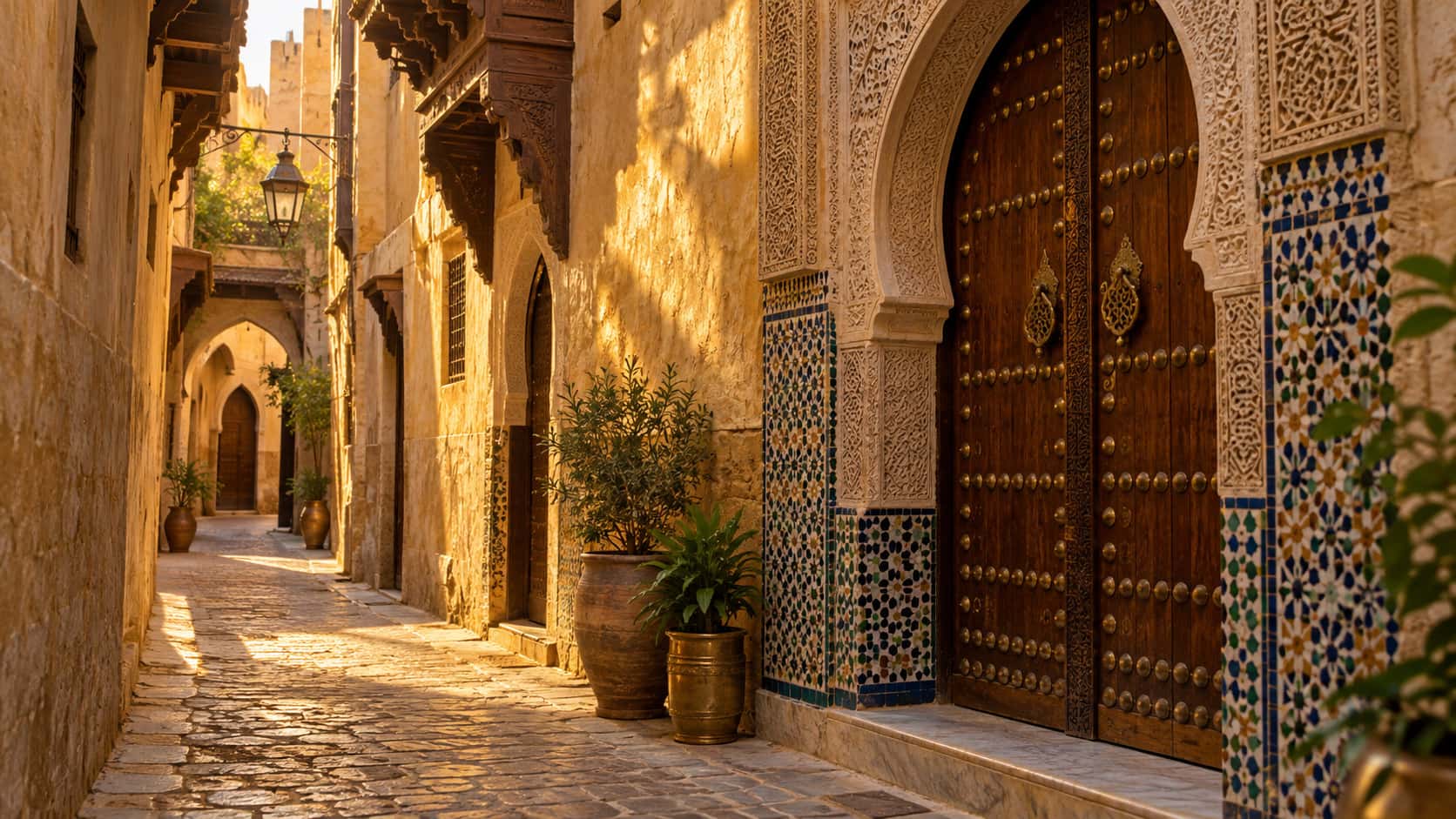
Buying Property in Fes: The Medina, the New Town and the Trade-Offs
8 October 2026 · 7 min read · Fes · Morocco
Buying property in Fes means choosing between two cities that happen to share a postcode: a UNESCO-protected medina built for pedestrians and pack animals, and a modern town built for cars, offices and ordinary family life. The ownership rules for a foreign buyer are the same wherever in the city you look. What changes completely, depending on which half you buy into, is how the property is titled, what you are allowed to do to it, and who will actually want to rent it from you.
We work with buyers based in Paris, Brussels, Montreal, London, Madrid and Dubai who are drawn to Fes for its history rather than its beaches, since it has little in common with the resort coastline that draws buyers to Agadir or Tangier. It is also a large, working city, not a museum piece: the commune counted 1,167,842 residents at the 2024 census, with the wider Fes prefecture reaching 1,256,172, according to Morocco's High Commission for Planning. Most of those people live well outside the walls that make Fes famous, which matters more than it first appears.
Nothing here replaces a lawyer checking the actual title or a notary running the actual sale. It is the context you need before you call either of them in.
The medina: a UNESCO site with its own rulebook
Fes el-Bali, the walled old city that gives Fes its international reputation, was inscribed by UNESCO as the "Medina of Fez" in 1981, Morocco's first World Heritage Site (whc.unesco.org). The listing protects the old city's urban fabric and walls along with a buffer zone around them, and it is why the medina remains one of the largest car-free urban centres in the world: nothing with wheels moves through its narrow derbs, only handcarts and pack animals.
For a buyer, that status is not decorative. Anything that touches the protected fabric, a riad's facade, a load-bearing wall, a courtyard, sits inside the restoration framework that governs historic monuments in Morocco, and in Fes that framework is applied on the ground by ADER-Fès, the state agency responsible for rehabilitating the medina under the law of 25 December 1980 on the conservation of historic monuments and sites. A riad bought inside the walls is not a blank canvas. It is a heritage building, and a body outside your control has a say in how you change it.
Many riads here still carry melkia rather than a registered title, and establishing which form of ownership a specific riad holds matters more inside the medina than almost anywhere else in Morocco, because a heritage restriction stacked on an unclear title can turn a straightforward purchase into a much longer one.
The Ville Nouvelle: the easier, more liquid half of the city
Outside the walls, the Ville Nouvelle is a different proposition entirely. Built up through the twentieth century as Fes grew beyond its original footprint, it is a grid of wider streets, standard apartment blocks and the city's main administrative and commercial life, centred on Avenue Hassan II and the area around Place Florence. None of the medina's heritage restrictions apply here. A flat in the Ville Nouvelle is bought, renovated and resold the same way as a flat anywhere else in urban Morocco.
The national ownership rules are identical in both halves of the city: a foreign buyer registers a title in their own name under the same regime whether the building sits inside the walls or three kilometres outside them. What differs is liquidity. New-build and recent apartments in the Ville Nouvelle carry a registered title far more consistently than an old riad does, which makes them simpler to finance, simpler to value and simpler to resell, and the more straightforward entry point for a first purchase in Fes.
Who actually lives in Fes, and why it matters for rental demand
What surprises most buyers who have only seen Fes on a map is how few residents actually live inside the walls. The Fes-Médina arrondissement, which covers the old city, counted just 49,775 people in the 2024 census, against the 1,167,842 counted across the whole commune, according to the same High Commission for Planning figures. The other million-plus live in the Ville Nouvelle and the newer districts that surround it.
That split matters for anyone thinking about rental income. Fes carries a large, settled population tied to public administration, education and a crafts and textile economy, not a tourist calendar that fills apartments in August and empties them by November. We do not publish rental yields or average prices because we hold no verified market dataset; what the population split tells you is where the steady, year-round tenant base actually sits, and for most of the city that is outside the walls rather than inside them.
Buying a riad: what the heritage rules mean in practice
Buying a riad to renovate is a specific kind of project, not a smaller version of buying an apartment. Vehicle access stops at the edge of the medina, so every tile, beam and bag of plaster goes in by hand or by cart. Many riads have sat empty or semi-derelict for years, which means the first real cost is usually structural: a proper survey of the roof, the courtyard drainage and the load-bearing walls before you agree a price, not after you have paid a deposit.
Because the building sits inside a protected perimeter, renovation is not simply a matter of hiring a contractor and starting work. Running the same checklist you would use on any resale property matters even more here, with one addition specific to the medina: get it in writing, before you commit, what ADER-Fès or the relevant heritage authority will and will not let you change.
Getting to Fes
Fes is served by Fès-Saïss Airport, about 12km south of the city, according to ONDA, the state body that operates Morocco's civil airports. It is the only airport serving the city directly, which is what most buyers viewing property in Fes will use rather than routing through Casablanca or Tangier and driving in.
For a buyer who plans to split time between Fes and the coast, factor the journey in before you commit to a specific neighbourhood. A property in the Ville Nouvelle, close to the main roads out of the city, is a different proposition for a part-time owner than a riad reached only on foot from the nearest car park at the medina's edge.
What to check before you commit
If you want to see what is genuinely for sale in Fes before narrowing anything down, the WhatsApp group publishing the city's real listings as they come up is faster than any portal.
- Decide medina or Ville Nouvelle first, since the two halves of Fes are regulated, financed and resold differently, and that choice shapes almost everything that follows
- Get a structural survey before agreeing a price on any riad, since the real cost of a medina renovation is usually in the roof, the courtyard and the walls, not the fittings
- Ask ADER-Fès or the relevant heritage body in writing what you will and will not be allowed to change before you commit to a renovation budget
- Work out how you will actually get between your property and the airport, since the answer looks very different for a Ville Nouvelle flat than for a riad reached only on foot
Frequently Asked Questions
Yes, under the same national rules that apply anywhere in urban Morocco: a foreign national can register a title in their own name with no residency requirement. The one general restriction in the country is on land classed as agricultural, which does not apply to property inside the medina or the Ville Nouvelle.
Want to see what's actually for sale in Fes right now?
Listing portals lag behind the real market. Join the free WhatsApp community for Fes to see riads, Ville Nouvelle apartments and new-build flats as owners, agents and developers post them.
Join the Fes Community