Buying Property in Kenitra: The Growth Corridor North of Rabat
9 November 2026 · 8 min read · Kenitra · Morocco
Buying property in Kenitra means buying into the province adding people faster than anywhere else in the Rabat-Salé-Kénitra region, a free zone drawing car-parts and electronics manufacturers from three continents, and an Atlantic coastline at Mehdia that most buyers only discover once they are already looking. The ownership rules are no different to anywhere else in Morocco. What is different is the shape of the demand behind the market: a growing industrial workforce that needs somewhere to live, a direct high-speed line into Rabat and Casablanca, and a city that has not yet run out of room to build.
We work with buyers based in Paris, Brussels, Montreal, London, Madrid and Dubai, and Kenitra tends to come up once someone has already looked at Rabat and wants a lower price for a similar commute, or once they have read that the province now counts more people than the capital's own prefecture. This is a guide to why that is happening and what to check before any of it, not a pitch for any one neighbourhood.
None of this replaces a lawyer reading the actual title or a notary running the actual sale. It is the context to bring with you before you call either one in.
Why Kenitra is the fastest-growing part of the region
Kénitra province, which takes in the city itself and the communes around it, counted 1,284,247 people at the 2024 census, according to Morocco's statistics authority, the Haut-Commissariat au Plan, more than any other province or prefecture in the Rabat-Salé-Kénitra region and ahead of Salé's 1,089,554 and Rabat's own 515,619. Of the 551,773 people the whole region added over the previous decade, Kénitra province accounted for 40.4% of that growth, the single largest share of any province or prefecture in the region.
That is a different story to Rabat, whose own prefecture actually lost population over the same ten years as its built-out centre ran out of room. Kénitra is still urbanising rather than built out: only 57.9% of the province's population lived in towns and cities in 2024, against more than 90% in Salé and Skhirate-Témara and 100% in Rabat itself, which is exactly why there is still land here to develop. Fertility in the province also stayed above replacement level, at 2.14 children per woman in 2024 against a regional average of 1.91, one of only three provinces in the region where that held true, which points to continued household formation rather than a population simply ageing in place.
A free zone pulling in international manufacturers
East of the city, in the commune of Amer Saflia, the Atlantic Free Zone covers 345 hectares split between a duty-free zone and a free zone proper, according to Caisse de Dépôt et de Gestion (CDG), the state financial institution behind its development. CDG states the site was built at a cost of 1.2 billion dirhams and is aimed at eventually supporting 30,000 jobs, with the American auto-parts maker Lear and the Japanese cable manufacturer Fujikura named among the companies already established there alongside vehicle assembly operations that have made Kénitra one of the anchors of Morocco's automotive export industry, including a plant run by the carmaker Stellantis.
That kind of investment brings a tenant base a seaside town does not get on its own: engineers, managers and technicians posted to the zone for years at a stretch rather than a season. For a buyer thinking about letting a flat year-round rather than chasing a summer crowd, that workforce is the demand worth understanding before anything else.
The pull for these manufacturers is largely geography: Kénitra sits within easy reach of the Tanger Med port complex to the north, which gives an exporter based here quick access to European markets without the costs of operating inside Tangier itself. That is also why the zone leans so heavily on automotive equipment, logistics and electronics rather than tourism or retail, a different economic base to almost every coastal city further south.
Connected to Rabat and Casablanca by rail
Kénitra sits directly on the route of Al Boraq, Morocco's high-speed line linking Tangier, Rabat and Casablanca, which opened on 15 November 2018 and runs over 363km at speeds of up to 320km/h, Railway Gazette International reported. That puts central Rabat and Casablanca within reach by a single fast train rather than a long drive, which helps explain why the province is absorbing so much of the region's new housing: it is possible to live in Kénitra and still work in either city.
Conventional ONCF services run the same corridor for buyers who are not chasing the fastest timetable, and the city's position on the Sebou river has made it a transport and trading point since long before any railway existed. A flat here can mean a working day that starts with coffee in Kénitra and ends with a meeting in Rabat, something the older conventional line alone never quite made practical, and it is one of the clearest reasons the city pulls commuters that Rabat itself can no longer house.
Mehdia and the Atlantic side of Kenitra
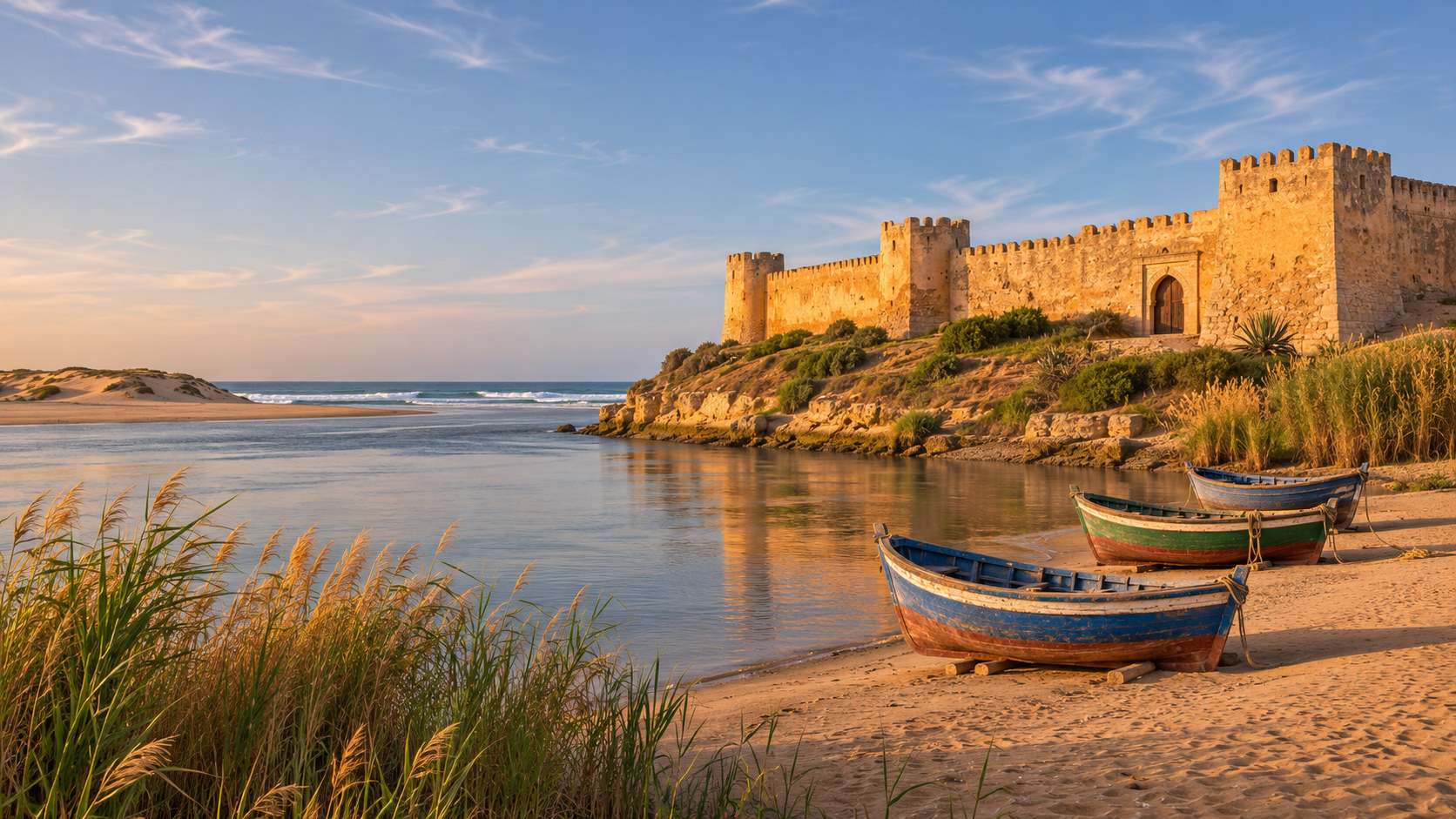
The city's other identity sits a few kilometres west, where the Sebou river reaches the Atlantic at Mehdia. The beach here draws Rabat and Kénitra's own residents on a weekend rather than a package-holiday crowd, surfers come for a wave that breaks at the river mouth, and an old sand-coloured kasbah built under the Almohad dynasty still looks out over the water. We hold no verified pricing data for this stretch of coast, so treat any asking price you see on a portal as a starting point, not a benchmark, and ask in the WhatsApp community what similar properties have actually sold for recently.
Buying here is a different proposition to buying near the free zone: a weekend or retirement property first and a rental asset second, competing for an entirely different tenant to the engineer renting a flat for a three-year posting inland.
What to check before you buy in Kenitra
- Confirm whether the specific property carries a registered titre foncier or an older melkia deed, since the difference decides how safely a purchase can actually proceed, and older streets near the river and the port are more likely to carry the older kind.
- Get a full written breakdown of the registration duty, land registry charges and notary's fee before agreeing a price, since none of them are already built into a listing's asking figure.
- Decide honestly whether you are buying a rental flat for the free zone's workforce, a commuter property for someone working in Rabat, or a weekend place near Mehdia, since the three markets behave differently and compete for different tenants.
- Ask what a specific plot was used for before the free zone and the newer suburbs were built, since industrial and former agricultural land near a fast-growing city does not always convert to clean residential title.
- If you are buying to let to the free zone's workforce, ask about the commute to Amer Saflia itself, since renters working there value an easy route more than a prestigious address.
Buying in Kenitra from abroad
The national ownership rules do not change from one Moroccan city to the next: a foreign buyer registers a title in their own name here exactly as anywhere else in Morocco, with the usual exception for land classed as agricultural, which is worth raising early given how much of Kénitra's growth is happening on land that was farmland within living memory.
What the province adds is momentum: a workforce that keeps arriving for the free zone, a direct line into two bigger cities, and a population that outgrew every other part of the region over the last decade. If you want a feel for what is genuinely on the market before narrowing anything down, the WhatsApp community for Kénitra is a faster read on a street than any portal, and it is the place to ask what similar flats near the free zone or out toward Mehdia have actually sold for.
Frequently Asked Questions
Yes. Ownership rules for a foreign buyer are set nationally and do not change by town, so the same rules that apply in Rabat or Casablanca apply here, with the usual exception for land classed as agricultural. That exception matters more in Kénitra than in an older, fully built-out city, since so much of the province's newer housing sits on land that was farmland until recently.
Want to see what's actually for sale in Kenitra right now?
Listing portals lag behind the real market here. Join the free WhatsApp community for Kenitra to see flats near the Al Boraq line, plots in the growing suburbs and villas toward Mehdia as owners, agents and developers post them.
Join the Kenitra Community